
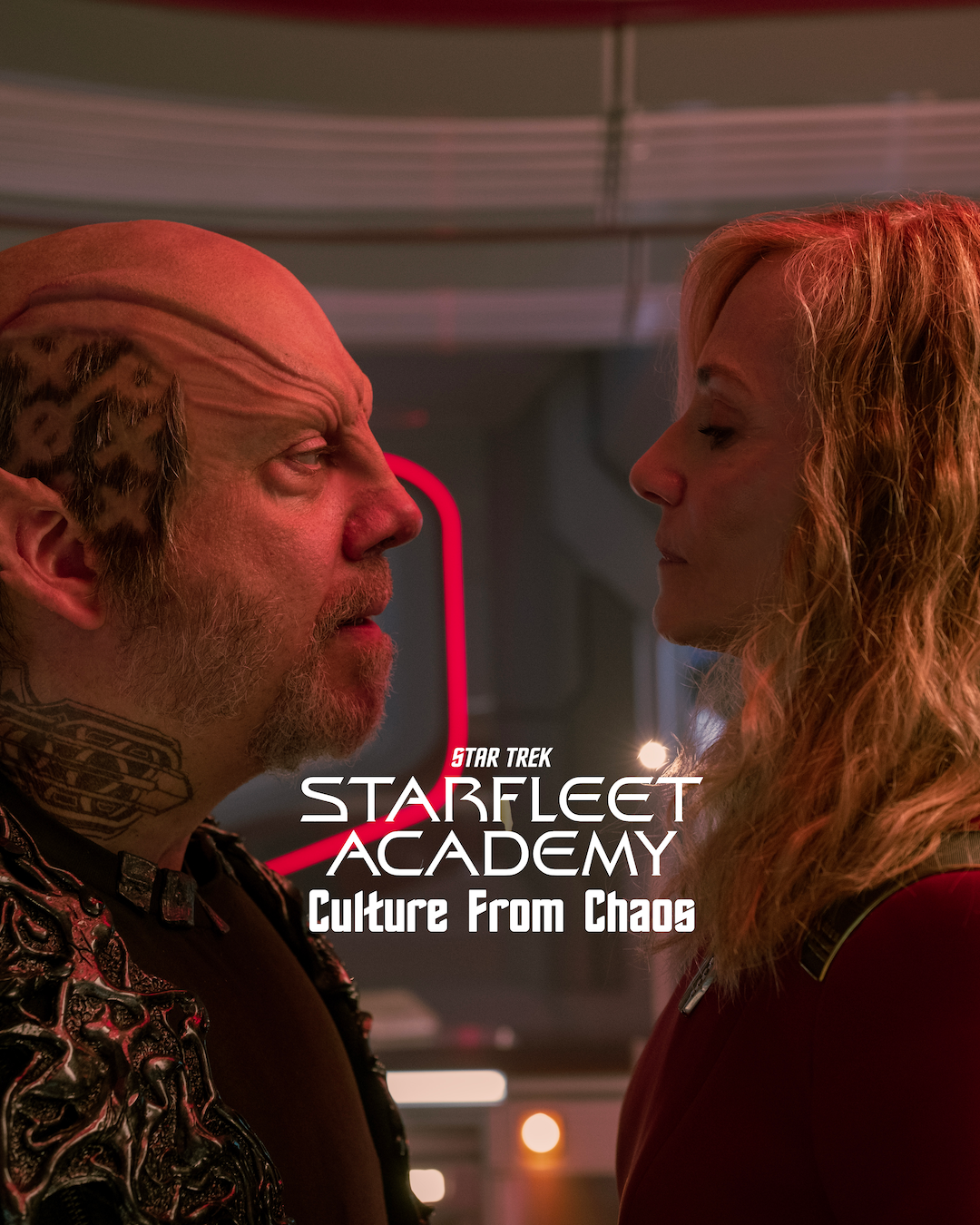
The future does not arrive tidy. During the global press conference for Star Trek: Starfleet Academy, Holly Hunter and Paul Giamatti made it clear that this series launches inside a wounded Federation and asks a new class to rebuild. As a casual who has chased this franchise’s ideals my entire life, I heard a mission statement. This show starts with fracture, then it challenges young cadets to turn crisis into culture. Something my generation knows all too much about.
The Federation Begins In Flux, Not Comfort

To ground the stakes, Hunter framed the series as an honest look at conflict and change. That framing sets the tone for every choice the Academy makes.
“Well, I think, you know, that stories are always about conflict. And the world is always in flux. And often, we write stories about broken worlds and how we are going to evolve from that. Because we’re always in a state of change. And I think that Starfleet Academy, but also Star Trek, is constantly examining that flux.”
Hunter does not romanticize the moment. She links the show’s narrative engine to how Star Trek has always worked: confront rupture, examine it, and evolve. That is a promise of forward motion, not comfort.
The Burn Still Echoes, And The Starfleet Academy Answers

Hunter then locates the series precisely in the franchise timeline, tying the Academy’s mandate to a century-old catastrophe fans already know.
“And we start with the Federation in Starfleet Academy is in a real state of transition. And the transition is a rough one. You know, from The Burn 125 years ago. And so, they’ve got to evolve to this new world. And so this is the beginning of that exploration of that story, of that conflict.” STAR TREK STARFLEET ACADEMY – 0…
RELATED: Star Trek: Starfleet Academy Review – Hope, Hard Lessons, And Gorgeous New Frontiers
The Burn is not a throwaway reference. It is the lingering scar that makes this setting urgent. By placing cadets at the point of recovery, the show turns coursework into consequences. Evolution stops being abstract and starts being survival.
Paul Giamatti Says The Trouble Is The Point

Giamatti, who knows a thing or two about complicated men and messy systems, backed that thesis by underlining how unusual it is to see the Federation this vulnerable.
“Yeah. No, I agree. I mean, science fiction in general is about sort of change and growth and the future and inheriting the future and things like that. So it’s always gonna be about, hopefully, trying to improve your lot now, trying to make things better. You know, and Star Trek is very much about, you know. And as Holly says, you know, the Federation is in a transitional state here, which is exciting and different and new. And troubling. The Federation’s not supposed to be in trouble. You know, the Federation is the vanguard that’s making sure everything’s okay. So, you know, it’s interesting.”
That line, “The Federation’s not supposed to be in trouble,” hits like a sonic boom. It reframes the Academy not as a safe campus drama, but as the frontline where optimism must be re-earned.
Built For The Next Generation, Literally

Giamatti then tees up the creative heart of the series: this is a story about building people who will rebuild everything else.
“And to have it at Starfleet Academy is great, ’cause it’s all about the future generations and building character so that they can sort of move forward and help out and change things.”
RELATED: South Park: Born in Chaos Comes Crashing into Fortnite
That is the playbook. You form cadets who can handle a reality that does not match the brochure. You build character first, then ships, then peace.
Why Starting From Hurt Makes Hope Feel Earned

Taken together, Hunt and Giamatti sketch a thesis I love as a longtime fan: Star Trek works best when it treats hope as a discipline. By acknowledging The Burn’s aftershocks, admitting the Federation’s fragility, and centering a campus where growth is the whole point, Star Trek: Starfleet Academy turns ideals into actions. The cadets do not inherit a utopia. They inherit the work. That is the kind of pressure cooker where new icons are forged, and it is exactly the right canvas for the franchise’s 60th year.
Star Trek: Starfleet Academy premieres with two episodes on January 15, 2026, exclusively on Paramount+, with new episodes weekly through March 12.
About Star Trek: Starfleet Academy

Release Date: January 15, 2026
Showrunners: Alex Kurtzman, Noga Landau
Composer: Jeff Russo
Executive Producers: Alex Kurtzman, Noga Landau, Gaia Violo, Aaron Baiers, Olatunde Osunsanmi, Jenny Lumet, Rod Roddenberry, Trevor Roth, Frank Siracusa, John Weber
Production: Secret Hideout, Roddenberry Entertainment, CBS Studios
Cast: Holly Hunter, Sandro Rosta, Karim Diané, Kerrice Brooks, George Hawkins, Bella Shepard, Zoë Steiner, Robert Picardo, Tig Notaro, Oded Fehr,
Synopsis
STAR TREK: STARFLEET ACADEMY introduces viewers to a young group of cadets who come together to pursue a common dream of hope and optimism. Under the watchful and demanding eyes of their instructors, they discover what it takes to become Starfleet officers as they navigate blossoming friendships, explosive rivalries, first loves and a new enemy that threatens both the Academy and the Federation itself.
Which part of the Federation’s recovery are you most excited to see on screen? What qualities should a Starfleet cadet need when utopia cracks? How should the Academy balance idealism and accountability? Drop your thoughts in the comments or @me to continue the conversation.
KEEP READING: LEGO SMART Play Lights Up Las Vegas Sphere with a Brick-built Death Star

Leave a Reply