
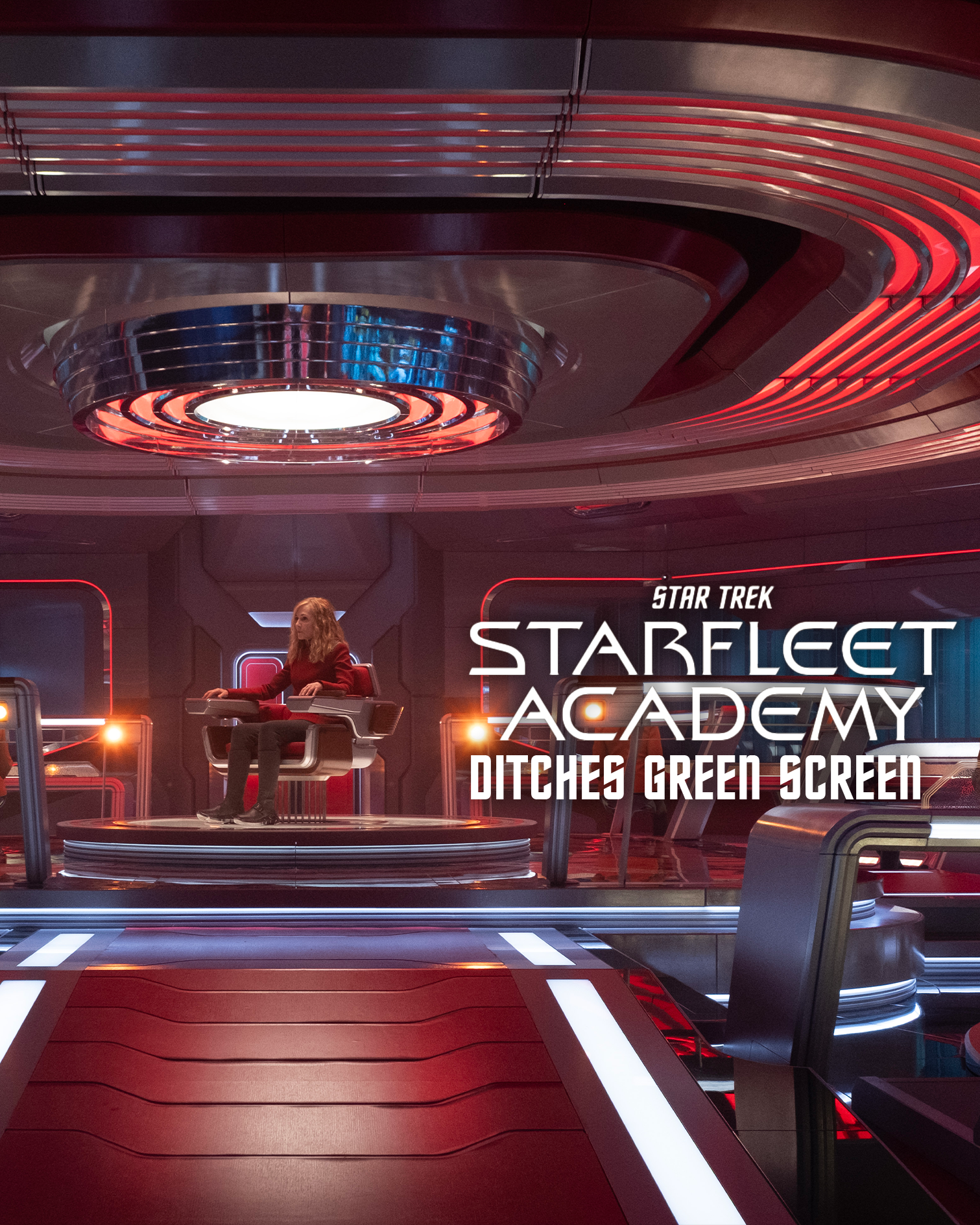
The new era of Star Trek decided to make the future feel physically present. During the global press conference, Holly Hunter and Paul Giamatti described a production built around a wraparound AR wall and massive practical builds that let actors move and react inside the world of Starfleet Academy.
Goodbye Green Screen, Hello AR Wall

Holly Hunter set the tone with a blunt answer about how the show was made.
“Well, look, there’s no green screen.”
That single line flips a switch. Instead of staring at a flat backdrop, the cast performs inside a live environment that lights faces correctly and gives real scale to every shot.
Hunter then explained the tool that replaces it.
“We do none. I mean, it’s all, they had this AR wall, so it’s.”
Even with that sentence cut short in the transcript, the point lands. The AR wall surrounds performers with the world, which means eyelines, reflections, and reactions all feel natural.
RELATED: Star Trek: Starfleet Academy: Paul Giamatti Might Be Star Trek’s Scariest Clown
Paul Giamatti backed her up with how the tech changes the craft.
“Green screen’s a little bit like a thing of the past in some ways.”
When the backdrop lives and moves with you, choices get bolder. Scenes can hold longer, and performances can breathe because actors stop pretending and start responding.
A Room Where Anything Feels Possible

Hunter walked through how the 360-degree volume affects your body and your imagination.
“Yeah. Green screens kind of don’t really. But this is a 360 degree you are in the environment. And it’s really fascinating. Can almost be a little bit you can lose your equilibrium slightly.
You can get a little dizzy because you are so surrounded by the world. But it’s fantastic. And it gives the scope of the show, you know, it’s just gigantic.”
Immersion has side effects. You feel it in your inner ear and in your gut. That sensation pays off on camera, because scale and awe register as real, not imagined.
RELATED: Inside Star Trek: Starfleet Academy: Cadets, Chaos, Command
Hunter tied that sensation to Trek’s core promise.
“It feels like in a way, as Star Trek does, anything is possible. And that’s one of the reasons why I think we all love doing the show as well, is because it feels like anything is possible for us.”
The tech is not a gimmick. It is a storytelling tool that lets a training ground for hope actually feel hopeful.
The Starfleet Academy Atrium You Can Walk, Climb, And Get Lost In

Giamatti singled out the heart of campus.
“You know, that atrium was, I mean, the bridge and all of them are amazing, but that atrium that goes up, you know, it only went three stories and the rest of it’s a CGI, but that was an incredible set.”
The blend matters. Build three stories you can touch, extend with CG you cannot, and the result tricks your senses in the best way.
RELATED: Empathy Is The Prime Directive In Star Trek: Starfleet Academy
And it is not just height. It is how fully the world surrounds you.
“I mean, it was beautiful. And you could really wander around it and find real spaces that were like this all feels like a complete world.”
You can stage character moments anywhere. Corners exist. Balconies invite. The camera explores without faking it.
Giamatti loved the play space it gave everyone.
“Yeah. Like there was all these places to play in it, and you could inhabit the whole, your mind could just expand to fill it. It was really great, you know. It’s really, really great. Beautiful set. Beautiful.”
RELATED: Star Trek: Starfleet Academy Starts In A Broken Federation, And That Is Exactly Why It Matters
When actors feel free to roam, scenes grow more dynamic. That freedom shows up as confidence on screen.
Making Tomorrow Feel Lived In

Live environments change performances. They speed up blocking, deepen interaction, and unlock scale that reads as honest. By replacing green screens with a 360-degree AR wall and towering practical sets, Starfleet Academy gives its cast a world to inhabit, not imagine. That choice supports a series about building a future, because the future finally surrounds the characters in every frame.
Star Trek: Starfleet Academy is now streaming the first two episodes, exclusively on Paramount+, with new episodes weekly through March 12.
About Star Trek: Starfleet Academy

Release Date: January 15, 2026
Showrunners: Alex Kurtzman, Noga Landau
Composer: Jeff Russo
Executive Producers: Alex Kurtzman, Noga Landau, Gaia Violo, Aaron Baiers, Olatunde Osunsanmi, Jenny Lumet, Rod Roddenberry, Trevor Roth, Frank Siracusa, John Weber
Production: Secret Hideout, Roddenberry Entertainment, CBS Studios
Cast: Holly Hunter, Sandro Rosta, Karim Diané, Kerrice Brooks, George Hawkins, Bella Shepard, Zoë Steiner, Robert Picardo, Tig Notaro, Oded Fehr
Synopsis
STAR TREK: STARFLEET ACADEMY introduces viewers to a young group of cadets who come together to pursue a common dream of hope and optimism. Under the watchful and demanding eyes of their instructors, they discover what it takes to become Starfleet officers as they navigate blossoming friendships, explosive rivalries, first loves and a new enemy that threatens both the Academy and the Federation itself.
Should Trek keep pushing AR walls and giant practical builds across the franchise? Which room at the Academy do you want to explore first? How does real scale change your hype for the show? Drop your thoughts in the comments or @me.
KEEP READING: Star Trek: Starfleet Academy Review – Hope, Hard Lessons, And Gorgeous New Frontiers

Leave a Reply