
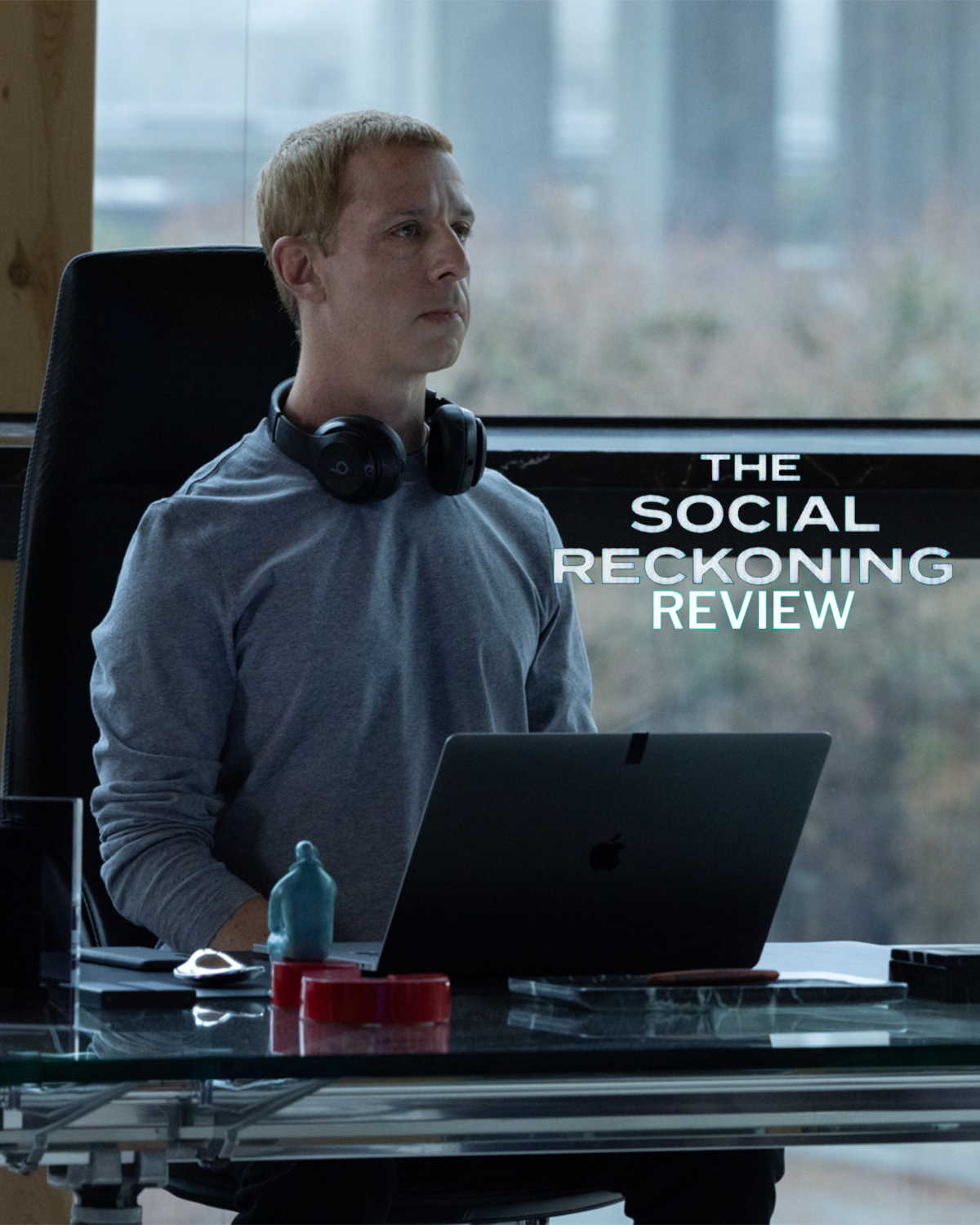
The Social Reckoning transforms algorithms, internal documents, congressional hearings, and corporate responsibility into an uncannily enjoyable two-hour thriller. Aaron Sorkin once again writes ridiculously engaging, universally palatable dialogue, but his greater achievement may be how dynamically he brings those words to life. Information becomes action. Conversation becomes combat. Mikey Madison and Jeremy Allen White carry the investigation with tremendous performances, Jeremy Strong captures Mark Zuckerberg’s almost robotic presence, and Bill Burr becomes the furious voice of reason slowly drowning beneath the machinery. I thoroughly enjoyed the cinematic experience. I am considerably less enthusiastic about how directly it reflects the world outside the theater.
Aaron Sorkin Makes Information Feel Like Action

Sorkin has always possessed an almost supernatural ability to make intelligent people explaining complicated ideas feel more thrilling than most explosions. The Social Reckoning gives him an especially difficult assignment. The film must explain Facebook’s algorithm, its internal culture, the principles of source protection, corporate public relations, congressional procedure, and the consequences of treating human attention like an endlessly harvestable resource.
That is a lot of information. In lesser hands, this becomes a lecture with famous people and expensive lighting.
Sorkin somehow makes it move.
The dialogue remains unmistakably his, filled with rapid exchanges, precise phrasing, unexpected punchlines, and people who can articulate a complete thesis while most of us are still deciding how to begin a sentence. Yet the writing remains remarkably accessible. The film never treats the audience like an idiot, but it also never demands a computer science degree to understand why a change to an algorithm can reshape political discourse, damage children, and reward the ugliest instincts in millions of users.
More importantly, Sorkin has become a far more dynamic filmmaker. He does not merely point the camera at talented actors and wait for the dialogue to generate momentum. Working with cinematographer Jeff Cronenweth and editor Alan Baumgarten, Sorkin turns newsrooms, redwood forests, corporate offices, rehearsal spaces, and congressional chambers into psychological battlegrounds.
The camera circles uncertain alliances, pushes into moments of realization, and isolates characters when the consequences become impossible to avoid. The editing braids timelines together without sacrificing emotional clarity. Every visual choice reinforces who possesses power, who thinks they possess it, and who has finally realized how little power anyone outside Facebook actually holds.
It is a masterful balance of show and tell. The film tells us an extraordinary amount because understanding the subject requires information. However, every new fact changes the pressure inside the room. Exposition becomes revelation, leverage, threat, or betrayal. Sorkin does not hide the vegetables. He sautés them in tension and serves them at the speed of a political thriller.
Mikey Madison Turns Thought Into Suspense

Mikey Madison delivers a beautifully internal performance as Facebook engineer and whistleblower Frances Haugen. Frances is brilliant, analytical, introverted, and initially devoted to what Facebook promised it could become. Her decision to expose the company does not emerge from hatred. It comes from the devastation of realizing that an institution she believed in understands the harm it causes and repeatedly chooses growth over responsibility.
Madison makes Frances’ intelligence feel active even when she is silent. You can see her calculating variables, reconsidering risks, and trying to solve moral problems with the same analytical precision she would apply to data. Her stillness never becomes emptiness. It becomes pressure.
She also captures the personal terror beneath whistleblowing. Frances is not simply handing over documents. She is surrendering anonymity, community, professional identity, and control over how her story will be used. Madison allows that fear to live alongside Frances’ conviction. She never turns her into a spotless cinematic hero who knows exactly what to do. She plays someone who recognizes that remaining silent has become morally impossible, even though speaking may destroy the life she built.
Sorkin gives Madison pages of exacting dialogue, but she never sounds like she is delivering Aaron Sorkin dialogue. Every carefully structured argument emerges through Frances’ particular way of thinking. Madison makes the words feel discovered rather than memorized. That is not easy.
Jeremy Allen White Gives Journalism a Human Cost

Jeremy Allen White is equally excellent as Wall Street Journal reporter Jeff Horwitz. Jeff enters the story as a tech outsider who can barely speak the language of the industry he has been assigned to investigate. White makes that ignorance funny without making Jeff incompetent. His lack of technical fluency becomes an advantage because he keeps asking the basic human question that everyone inside the machinery has learned to avoid: What is this doing to people?
White gives Jeff a wonderfully rumpled intelligence. He is curious, tenacious, skeptical, and increasingly aware that publishing the truth requires another person to absorb most of the danger. His relationship with Frances gradually shifts from transactional necessity into genuine trust, and White captures the guilt developing underneath that bond. Jeff needs her documents. He also begins to understand that every breakthrough in his investigation pushes her closer to a point from which she cannot return.
Madison and White carry the bulk of the story, and their chemistry gives the film its emotional engine. Their characters frustrate, test, and cautiously protect each other. Neither instantly trusts the other, and the film never manufactures intimacy before earning it. Their alliance develops through shared risk, intellectual respect, and the unsettling realization that they may be the only two people who completely understand what they are attempting.
The two performers are spectacular individually. Together, they make the exchange of information feel as dangerous and intimate as passing classified plans behind enemy lines.
Jeremy Strong Captures the Machine Wearing a Man

Jeremy Strong plays Mark Zuckerberg, and holy shit does he capture the almost robotic presence Zuckerberg regularly projects.
Strong does not imitate Jesse Eisenberg’s younger interpretation or attempt to recreate The Social Network. This Zuckerberg has changed. He no longer feels like an ambitious programmer fighting his way into elite rooms. He controls the rooms, the security surrounding them, the information entering them, and increasingly, the public conversation happening outside them.
Strong captures Zuckerberg’s rigid posture, controlled voice, delayed reactions, and unnerving ability to translate human consequences into operational complications. He feels like a man who processed himself into an interface. Even moments that could resemble vulnerability appear to pass through an internal system designed to determine what response will produce the most useful outcome.
The performance remains restrained, but never passive. Strong makes every pause feel like a calculation. When Zuckerberg listens, it rarely feels as if he is reconsidering his beliefs. It feels as if he is searching for the most efficient way to absorb, redirect, or neutralize the argument.
Crucially, the film does not humanize Zuckerberg or Facebook into absolution. Strong makes Zuckerberg understandable as a concentration of power without asking us to sympathize with what that power has done. Understanding how the machine operates is not the same as forgiving everything it crushes.
The Social Reckoning also resists inventing an easily digestible supervillain. It does not need secret lairs, malicious speeches, or fictional atrocities when the public record already demonstrates the scale of the damage. The horror comes from decisions made in conference rooms by people who can describe catastrophic consequences with the emotional urgency of adjusting a quarterly forecast.
Bill Burr Is the Voice Drowning in the Machine
Bill Burr deserves special applause for his performance as Charlie Garrigan, a former Facebook insider who has become one of Zuckerberg’s fiercest critics. Burr brings his natural passion, anger, humor, and intolerance for bullshit into Sorkin’s verbal arena, and the combination works beautifully.
Charlie understands Zuckerberg well enough to know that ordinary moral appeals will bounce directly off him. He needles, challenges, provokes, and occasionally insults because he is desperately searching for a frequency that might penetrate the corporate insulation. Burr makes every confrontation feel personal. Charlie is not only furious about what Facebook became. He is grieving what everyone once believed it could be.
There is also something painfully familiar about watching Burr become the singular voice of reason in a room designed to absorb dissent without changing course. He raises his voice because quiet objections have already failed. He brings facts, history, experience, and moral clarity, yet the system surrounding him can convert every warning into another messaging problem.
Burr’s natural intensity keeps Charlie from becoming Sorkin’s designated speech-delivery device. His frustration feels physical. He is not performing righteousness. He is watching someone continue driving toward a cliff while calmly explaining that the brakes are functioning exactly as designed.
Wunmi Mosaku, Betty Gilpin, and Billy Magnussen further strengthen the ensemble by embodying the institutions surrounding this conflict. Mosaku brings composure and social intelligence to crisis strategist Raya Akinola. Gilpin makes newsroom authority feel sharp enough to draw blood. Magnussen captures the polished emptiness of corporate messaging built to prevent accountability from acquiring a name or face.
The Meta Surreality Is Impossible to Escape

As much as I enjoyed The Social Reckoning, the film is almost too real.
I will almost certainly use Facebook, Instagram, or another Meta-owned platform to promote this review. I am criticizing the machinery while feeding it content, attention, engagement, and free advertising. The hypocrisy is difficult to ignore.
That contradiction is also the trap.
Meta’s platforms have become essential distribution tools for journalists, artists, small businesses, community organizers, and independent publications. Many of us recognize that the system rewards misinformation, anger, cruelty, and division, yet leaving it means surrendering access to audiences we spent years building. We condemn the machine, then return to it because the machine successfully positioned itself between us and the people we need to reach.
Facebook is currently a tool for evil, and millions of us willingly contribute to and promote its continued existence. Not necessarily because we support what it has become, but because participation has been transformed from a choice into infrastructure.
Watching the film while the sitting president can casually speak about Los Angeles and San Diego being “taken out” as a “small price to pay” makes its warning feel especially sickening. A statement that should produce universal condemnation instead enters the same engagement economy the film dissects. It becomes clipped, shared, defended, distorted, monetized, and algorithmically delivered to whichever audience will remain angriest for the longest.
The Social Reckoning is not depicting a threat gathering somewhere over the horizon. We are living inside the result.
A Warning That Arrived After the Damage
The film is a thoughtful and important examination of how social media reshaped public conversation, but its warning feels too little, too late.
Sorkin still believes in the power of a perfectly constructed argument. His characters gather evidence, challenge authority, expose hypocrisy, and attempt to drag society toward reason through language. In more civil times, The Social Reckoning might have nudged the world toward greater accountability and a healthier public discourse.
Then again, I thought The Newsroom might make people respect journalism, intellectual honesty, and informed disagreement.
We can see how that worked out.
Maybe Sorkin’s work is too highbrow for the people who most need to hear it. The audience capable of appreciating a two-hour dialogue-driven drama about algorithmic accountability probably already understands that Facebook has become a malignant force. The people deepest inside its manufactured reality may never watch the film. If they do, the algorithm may have already told them what to believe about it.
That does not make the film unnecessary. It changes what the film can accomplish. The Social Reckoning may not stop the machine, but it can document how the machine was built, who understood its dangers, and which decisions allowed those dangers to become features.
Sometimes a warning arrives too late to prevent the fire. It can still identify who kept pouring gasoline.
Two Hours Disappear, Even If the Problem Does Not
Despite the overwhelming real-world implications, The Social Reckoning is never unbearably heavy. Sorkin knows when to deploy humor, when to let characters breathe, and when to allow the escalating investigation to take control. The film remains an engrossing piece of entertainment even as it forces audiences to confront their own participation in the system.
The two hours disappear. That is the clearest testament to Sorkin’s storytelling. He turns documents, meetings, algorithms, and ethical arguments into a gripping cinematic experience without trivializing their importance. Madison and White provide its heart, Strong embodies its chilling concentration of power, and Burr supplies the moral fury threatening to boil over.
I thoroughly enjoyed The Social Reckoning. I also left wondering whether a film this intelligent, accessible, and urgent can reach beyond the people already prepared to listen.
In a better moment, it might inspire reform. In this one, it may simply prove how long we have known better.
8/10
The Social Reckoning opens exclusively in theaters on October 9, 2026.
Ready to follow Frances Haugen and Jeff Horwitz into the machinery behind Facebook? Will Sorkin’s latest make you reconsider what you feed the algorithm? Can a warning this smart still change anything, or has the reckoning arrived too late? Share your thoughts in the comments or @me.
KEEP READING:
Leave a Reply