
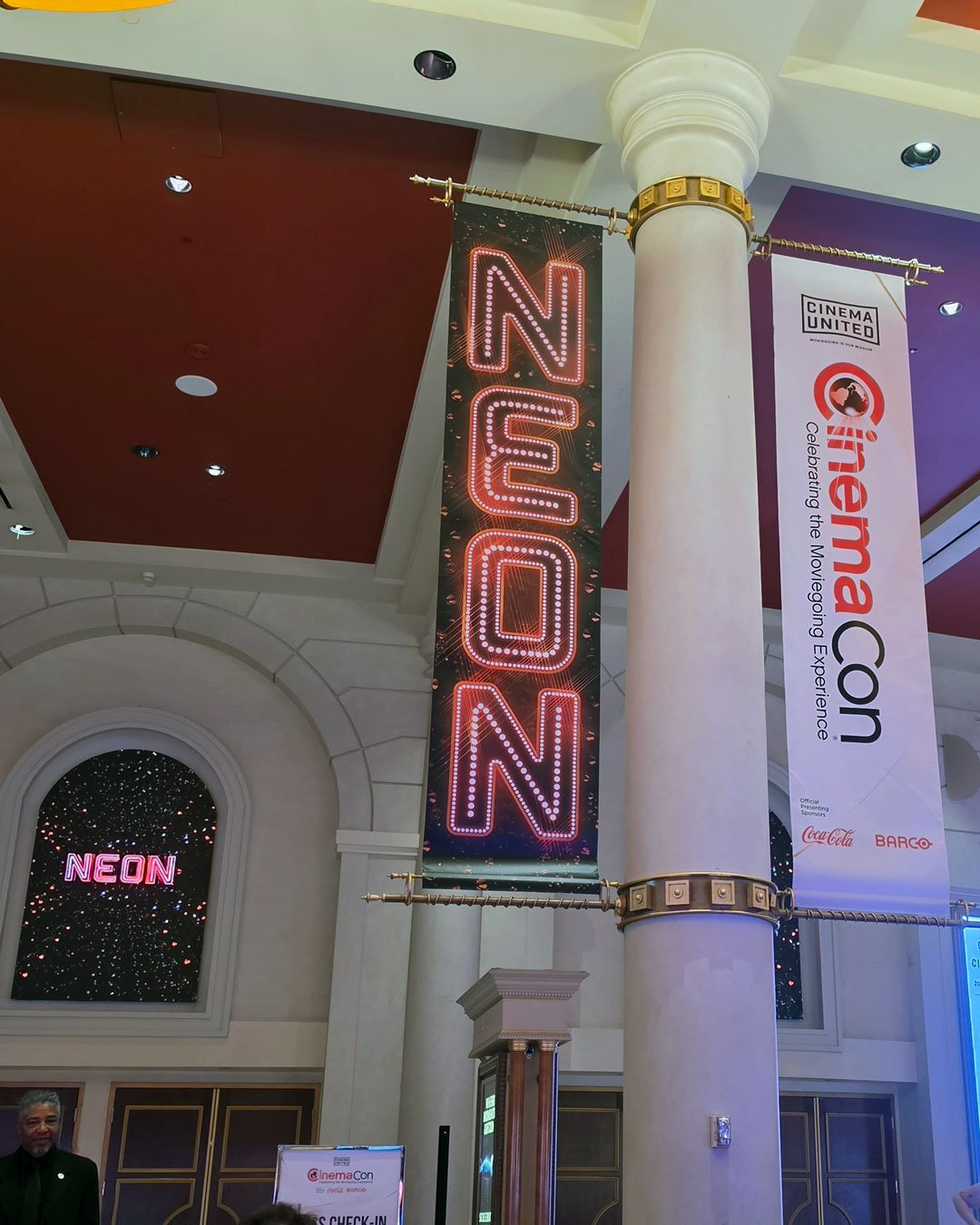
Neon did not use CinemaCon to play defense. It used the stage to argue that theatrical originality still has real box office force. Elissa Federoff, Neon’s Chief Distribution Officer, framed the company’s pitch clearly, saying Neon wants to give audiences something they cannot get anywhere else, and the slate backed that up with horror, fashion-fueled chaos, queer thrillers, and a huge Korean sci-fi swing.
Neon’s Theatrical Identity is Built on Risk

The strongest throughline in Neon’s presentation was not one single movie. It was a philosophy. The studio presented itself as a company built around singular voices, sharper swings, and films that need a room full of people to fully land.
“What connects everything you’ve seen today is a simple idea. That the future of this business depends on originality and bold voices and on films that give audiences a reason to leave home.”
- Elissa Federoff
That point defined the whole presentation. Neon leaned into independence as a strength, not a limitation. Federa argued that being independent lets the company move faster, take riskier bets, and put genuinely distinct work into theaters. That is why the slate felt less like a brand extension and more like a challenge to everybody else in the room.
Adam Scott’s Hokum Kicked Things Off With Dread
The first big punch came from Hokum, with Adam Scott introducing Damian McCarthy’s haunted hotel horror film as something rooted in folklore, atmosphere, and the kind of fear that lingers after the credits. Scott sold it less as a jump-scare machine and more as a movie that embeds itself in your brain.
“There are plenty of scares, but also that intangible third rail that only some are gifted enough to grasp. That is the work of Damian McCarthy.”
- Adam Scott
RELATED: Godzilla Minus Zero Sequel Roars Into CinemaCon as GKIDS Champions the Power of Theaters
That framing gives Hokum a strong identity right away. Scott made it sound like a horror movie chasing dread and memory instead of cheap noise, which is exactly the kind of genre pitch Neon has been getting good at making land.
Boots Riley Brought the Chaos, and the Rest of the Neon Slate Kept Swinging
If Hokum brought dread, I Love Boosters brought pure velocity. Boots Riley pitched the film as something visceral, colorful, and built to move like an amusement park ride, while Neon described it as a wildly original fashion-world crime comedy led by Keke Palmer, LaKeith Stanfield, Naomi Ackie, Demi Moore, Will Poulter, Taylor Paige, Havana Rose Liu, and Eiza González. Riley made it sound like the kind of movie that wants to overwhelm you on purpose.
Boots Riley also pitched I Love Boosters as the kind of movie that can turn into a real audience event, not just another release on the schedule. He told theater owners he was already seeing that energy firsthand on a college tour and predicted younger audiences would show up ready to make the film part of the experience itself.
“I want to say one more thing. I’m on a college tour right now and people are showing up in droves. They’re sold out, they’re waiting out there. Students, young people are going to show up dressed in monochrome outfits. It’s gonna be a thing. Make sure your theater has it on a bunch of screens. All the screens.”
- Boots Riley
Neon Energy

That energy carried into the rest of the slate. Leviticus was introduced as a provocative queer horror film centered on two teenage boys hunted by a violent entity that takes the form of the person they most desire. A Place in Hell pushed into psychological thriller territory with Michelle Williams and Daisy Edgar-Jones in a cat-and-mouse story about ambition, identity, and control. Then Neon closed with Hope, a brand-new acquisition from Na Hong-jin, described as a large-scale sci-fi action thriller starring Michael Fassbender and Alicia Vikander alongside major Korean stars.
Taken together, Neon’s CinemaCon presentation felt like one of the clearest arguments of the week for why independent film still matters on the big screen. The studio did not just promise variety. It promised movies that feel dangerous, specific, and impossible to mistake for anything else.

Which Neon title grabbed you first, Hokum, I Love Boosters, Leviticus, A Place in Hell, or Hope? Do you think this kind of originality is what theaters need most right now? Which project feels like Neon’s biggest breakout play? Share your thoughts in the comments or @me
KEEP READING: Sony Pictures CinemaCon 2026 Presentation Packs Its Slate With Spider-Man, Bloodborne, and Big-Screen Swings
Leave a Reply