
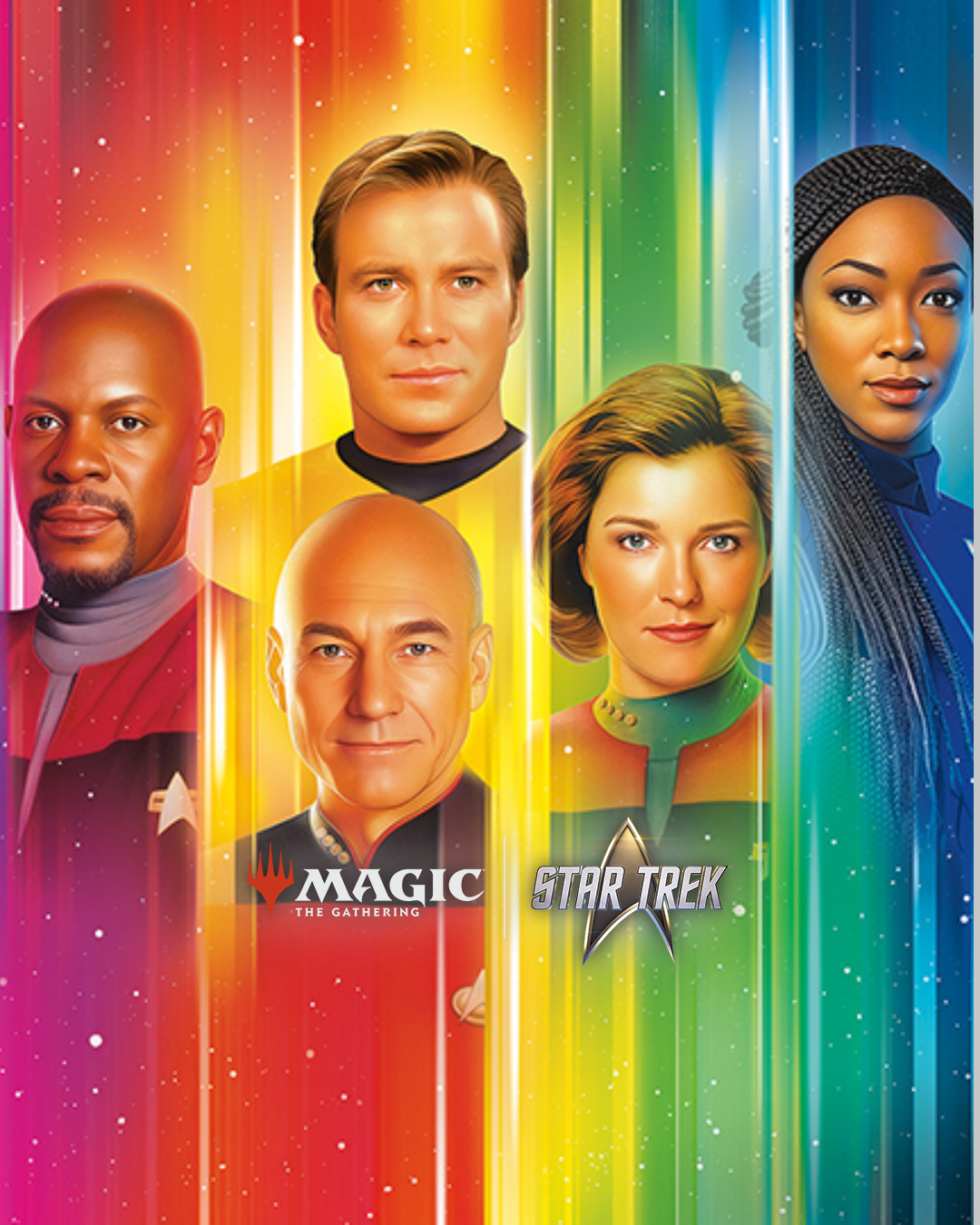
Magic: The Gathering is preparing to explore the final frontier with mechanics built around the defining ideas of Star Trek. Assimilate turns opposing creatures into Borg, Federation rewards diverse crews, face a dilemma makes difficult decisions mechanically meaningful, and strange new worlds encourages players to explore the galaxy through their mana bases. Transporters and returning Spacecraft complete a collection designed to celebrate 60 years of captains, crews, civilizations, and increasingly dangerous anomalies.
Assimilate Adds Creatures to the Collective

Resistance is about to become mechanically futile.
Assimilate allows a player to gain control of a creature or place a creature card onto the battlefield under their control. The assimilated creature receives a +1/+1 counter, becomes a Borg artifact creature, and loses its other creature types.
That process captures the Borg’s defining strategy with uncomfortable accuracy. Assimilation does not merely remove one of an opponent’s resources. It strengthens the Borg player’s battlefield and gives the Collective another artifact creature to enhance.
The creature’s original abilities remain intact unless another effect says otherwise. A powerful creature can therefore retain everything that made it dangerous while gaining a counter and joining a completely different kind of typal strategy.
Borg cards can also provide benefits to artifact creatures, allowing every new addition to improve an increasingly interconnected board. In Commander, repeated assimilation could become especially brutal because every captured creature weakens one opponent while strengthening its new controller.
Wizards first revealed the mechanic through Borg Queen, Perfection Manifest, placing the Collective’s most recognizable leader at the center of the strategy.
Face a Dilemma Rewards Difficult Decisions


Star Trek has always been defined by impossible choices as much as phaser battles. Face a dilemma turns those decisions into a named gameplay action.
A player faces a dilemma whenever they choose one or more modes for a spell or ability. The choice itself matters, regardless of which option the player selects.
RELATED: Magic: The Gathering Opens the Strange School With Two New Reality Fracture Secret Lair Drops
Set Phasers to… provides a flavorful example by asking players to choose between “stun” and “kill.” Seven of Nine can then reward players whenever they make that kind of modal decision.
The mechanic should interact with more than the new Star Trek cards. Older modal spells and abilities can also cause players to face a dilemma because the mechanic defines an action already found throughout Magic’s history.
That gives dilemma-focused decks access to an enormous pool of existing cards. Charms, commands, confluences, and any other effects asking players to “choose one” can potentially support the strategy.
Apparently, captains are not the only people who benefit from keeping their options open.
Federation Celebrates Infinite Diversity


The Federation grows stronger by bringing different species and cultures together. Its corresponding ability word rewards players for building similarly diverse crews.
Federation abilities care about the number of creature types represented among the non-Borg creatures a player controls. The more distinct types aboard the ship, the stronger the potential effect becomes.
A Human, Vulcan, Klingon, Android, and Trill would contribute far more variety than a battlefield filled exclusively with Humans. That encourages players to assemble a crew rather than focus on one traditional creature type.
Hoshi Sato, Exolinguist demonstrates how this diversity can translate into gameplay by scaling her ability according to the variety present on the battlefield.
Changelings cannot immediately maximize Federation by counting as every creature type. Since changeling gives them every type, they are also Borg and become excluded by the mechanic’s non-Borg requirement.
It is a small but clever rules detail. The Federation welcomes nearly everyone, but it is understandably cautious around members of the Collective.
Strange New Worlds Rewards Exploration


Strange new worlds encourages players to build a varied mana base and continue exploring as the game progresses.
The ability counts the number of differently named lands a player controls. Cards can then deliver increasingly powerful effects based on that total.
Basic lands with different names contribute naturally, but dual lands, utility lands, and other unique locations can help the number climb much higher. The mechanic should fit especially well inside multicolor decks already interested in playing several kinds of lands.
It also reflects Star Trek’s larger approach to exploration. Players are rewarded for seeking out new worlds instead of remaining surrounded by identical terrain.
The mechanic supports a slower style of play built around development and discovery. That aligns with the set’s broader emphasis on constructing engines and preparing for powerful late-game turns rather than immediately charging into combat.
Beam Me Up Turns Creatures Into Transporter Fuel in Star Trek

Beam me up gives instant and sorcery cards another life in the graveyard.
A card with beam me up can be cast from the graveyard for its listed alternative cost if its player also returns a creature they control to its owner’s hand. The spell is then exiled after it resolves.
Returning a creature may initially look like a drawback, but it can rescue someone from removal, reuse an enters-the-battlefield ability, or protect an important crewmember before a board wipe.
The mechanic also creates the unmistakable feeling of a transporter extraction. One permanent disappears from the battlefield while a spell unexpectedly rematerializes from the graveyard.
Decks filled with valuable enters-the-battlefield abilities should be able to turn that emergency transport into an advantage. The captain survives, the spell receives another use, and the opponent who thought everything was under control may need to reconsider.
Spacecraft and Station Return to the Helm


Spacecraft and station return from Edge of Eternities to represent the Enterprise, Defiant, Voyager, and other legendary ships.
A Spacecraft begins as an artifact rather than a creature. Players can use station abilities to place charge counters on it, gradually unlocking additional functions and potentially transforming it into a creature.
That progression captures the idea of a crew bringing a ship online. A vessel needs people at its stations before it can access its full systems, enter combat, and begin doing the impossible on a weekly basis.
U.S.S. Enterprise-D, Galaxy-Class demonstrates the scale available to the mechanic. Like other Spacecraft, it can provide value before becoming a creature, allowing it to feel like a functioning command center instead of an ordinary Vehicle waiting to attack.
The returning mechanic should also connect Star Trek with existing Spacecraft cards, giving players immediate opportunities to combine the new set with Magic’s established science-fiction designs.
The Final Frontier Opens in November


Magic: The Gathering | Star Trek celebrates characters and stories from across the franchise’s 60-year history. The main set will be legal in Standard and other rotating formats, while its Commander cards and special Stardates reprints will enter Commander, Legacy, and Vintage.
Prerelease events run November 6–12, followed by the set’s arrival on Magic: The Gathering Arena on November 10. The worldwide tabletop launch takes place November 13, 2026.

Will you build a diverse Federation crew or surrender your battlefield to the Borg? Which classic modal spell belongs in your first dilemma deck? What legendary Star Trek ship are you most excited to bring online? Share your thoughts in the comments or @me.
KEEP READING: Street Fighter Review – A Glorious, Ridiculous Knockout for the Fans
Leave a Reply