
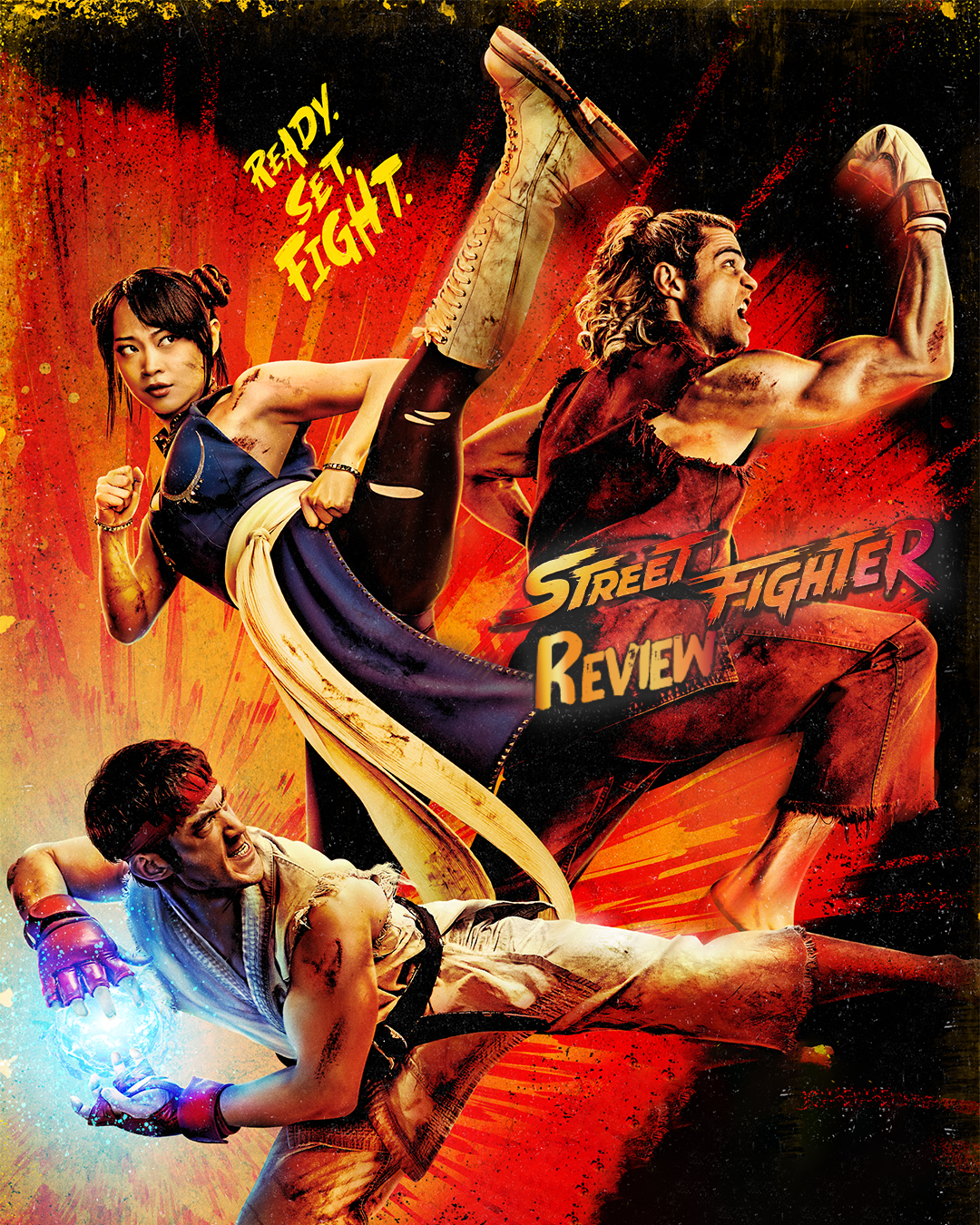
Street Fighter has absolutely no business being this good. A franchise with decades of lore, wildly different interpretations, a massive roster, multiple generations of fans, and a painful cinematic history should not fit inside one coherent movie. Somehow, director Kitao Sakurai crams the games, anime, comics, iconography, competitive scene, casual fandom, and beautifully strange culture surrounding Street Fighter into one outrageously entertaining package. The film is uneven, ridiculous, occasionally stupid, and so overflowing with affection that I could not stop smiling. It does not merely adapt Street Fighter. It understands why people have spent nearly four decades throwing fireballs at their friends.
Every Corner of the Street Fighter Fandom Enters the Arena

A LEGENDARY PICTURES Production “STREET FIGHTER”
Sakurai masterfully captures the franchise at every possible level. The lore matters. The relationships matter. The costumes, stages, moves, character introductions, sound cues, poses, victory celebrations, and background weirdos all matter. The film understands that Street Fighter is simultaneously an epic martial arts saga, an international tournament, an arcade obsession, a competitive institution, a Saturday morning cartoon, an anime, and one of gaming’s longest-running collections of attractive lunatics beating the hell out of each other.
The Easter eggs are everywhere, but they rarely feel like the movie pausing to hold something in front of the camera until fans clap. Homages to the opening sequence of Street Fighter II help connect the film to the moment the franchise became a worldwide phenomenon. Fighters and spectators populate the background like the beautifully repetitive crowds watching from classic game stages. Even when characters are not central to the story, their presence makes the world feel like a roster waiting for the next challenger.
Then the film goes deep enough to include fighting game legend Justin Wong in a cameo yelling for a parry. That is not a reference designed for someone who vaguely remembers playing Street Fighter at a pizza place. That is a laser-targeted joke for people who know exactly why one word can summon an entire historic competitive gaming moment.
The movie also acknowledges the gooners and their unnecessarily open Chun-Li obsession. It knows that part of the fandom exists. It knows they were going to be weird about Callina Liang. It looks directly at them and says, “Yes, we see you. Please consider behaving normally for five consecutive minutes.”
That joke is intentionally creepy and not one of the film’s most elegant swings, but its existence proves how completely Sakurai understands the entire ecosystem. This movie knows the scholars, the button mashers, the tournament competitors, the anime fans, the lore historians, and the people who have spent thirty years making Chun-Li’s thighs everyone else’s problem.
The Anime Opening Teaches Us How to Watch the Movie
Opening the film in anime is a genius decision.
Before live action can trigger questions about realism, physics, or how seriously any of this should be taken, Street Fighter establishes its rules through a medium built to embrace heightened emotion and impossible movement. The anime opening immediately prepares us for wild action, enormous personalities, theatrical poses, superhuman martial arts, and hi-jinks operating far beyond reality.
It tells the audience exactly what kind of ride they have boarded.
The film continues using anime for flashbacks and time skips, allowing memory and history to exist in their own heightened visual language. These sequences are not simply cheaper or faster ways to fill in backstory. They connect this adaptation to another beloved branch of the franchise while giving the characters’ pasts a mythic quality. Live action becomes the present. Anime becomes legend.
RELATED: The Social Reckoning Review – A Gripping Warning That Feels Too Little, Too Late
The transitions also prevent exposition from slowing the film down. Instead of watching characters stand around describing formative battles, we enter those moments through an entirely different style. Movement becomes more exaggerated. Emotion becomes more concentrated. The past feels enormous because this is how the fighters remember it.
That choice perfectly reflects the movie’s larger approach. Sakurai does not flatten every version of Street Fighter into one house style. He allows the different iterations to strengthen each other.
The World Finally Looks Like Street Fighter

The live-action world looks fantastic. The colors, costumes, architecture, lighting, crowds, and exaggerated production design capture the vibe of the games without making every frame resemble a painfully literal cosplay recreation.
This is a difficult aesthetic to translate. Make it too grounded and Street Fighter loses its personality. Reproduce every design without adjustment and the characters can look like they wandered out of a convention directly onto a multi-million-dollar set. Sakurai finds the sweet spot between recognizable and cinematic.
The fighters look like themselves, but they also look capable of existing in the same world. Their silhouettes remain iconic. Their colors communicate character. Their environments feel like the stages we remember without forcing every location to become a static one-to-one recreation.
Most importantly, the movie is not embarrassed by its source material. It does not drain the colors, hide the costumes, or spend half its runtime apologizing for names like M. Bison and Dhalsim. It understands that the theatricality is not an obstacle preventing Street Fighter from becoming cinema.
The theatricality is the point.
Callina Liang Is an Absolute Pro
Callina Liang is magnificent as Chun-Li.
From the marketing push alone, Liang has carried herself like an absolute professional and a genuine ambassador for the film. She understands the responsibility of playing one of the most recognizable women in video game history, and she has approached every appearance with enthusiasm, confidence, and obvious respect for the character.
That would already be impressive without considering the physical dedication required for the role. Onscreen, that work becomes undeniable. Liang moves with speed, control, power, and purpose. Chun-Li’s fighting style depends on her legs feeling like actual weapons, and Liang sells every kick with enough force to make the audience brace for impact.
However, physical preparation alone does not make the performance work. Liang captures Chun-Li’s intelligence, focus, impatience, compassion, and barely contained fury. She can take command of a room without pretending Chun-Li is emotionally untouchable. The character carries history into every confrontation, particularly when the larger conspiracy begins colliding with her personal mission.
Liang also nails the balance between playing the film straight and understanding its comedy. She never winks at the camera or treats Chun-Li like she is above the surrounding foolishness. Her commitment makes the ridiculous world feel more real, which only makes the comedy hit harder.
This is not an actor surviving an effects-heavy video game adaptation. This is a star claiming an iconic role.
Andrew Koji Finds the Warrior Inside Ryu

A LEGENDARY PICTURES Production “STREET FIGHTER”
Andrew Koji is a perfect Ryu.
Koji brings the weight, discipline, restraint, and internal conflict required for a character who could easily become an emotionless martial arts archetype. His Ryu is quiet because he is constantly managing something enormous inside himself, not because the screenplay forgot to give him a personality.
His accent and cadence are masterful. Koji draws from the deliberate rhythms and weathered gravity associated with warriors in classic Japanese samurai cinema, but the performance never collapses into a trope. He maintains the voice through humor, anger, pain, reflection, and some truly intense emotional turns. The accent never disappears when the acting becomes difficult. It remains an organic part of the character.
Koji communicates an extraordinary amount through posture and stillness. Ryu frequently appears to be the calmest person in the room, but his control never feels effortless. You can sense the pressure underneath it. Every clenched muscle suggests that discipline is an active choice.
That makes his explosive moments matter. When Ryu moves, the film unleashes everything he has been containing. Koji makes the transition from quiet warrior to terrifying force feel earned rather than obligatory.
He also understands that Ryu is not humorless. His seriousness becomes funny because it is genuine, especially when surrounded by characters operating at dramatically different frequencies. Koji never chases the joke. He lets Ryu’s absolute commitment collide with the absurdity around him.
Noah Centineo Gives Ken Something to Prove
Noah Centineo is a truly great Ken Masters because he understands the wound beneath the swagger. I only don’t say perfect because I feel like I’m saying it too much. But also to like add “credibility,” you can tell Noah Centineo is not a natural blonde. I mean, from his performance you can’t tell because he was incredible. But from his hair, it’s obvious. Not that he doesn’t look good as a blonde, just saying not a natural blonde.
Ken is Ryu’s equal, but he constantly feels like everyone else sees him as the sidekick. That insecurity gives Centineo far more to play than confidence, jokes, and expensive hair. His Ken is charismatic enough to command attention while remaining painfully aware that the legend forming around Ryu might eventually leave him behind.
Centineo makes Ken’s humor feel like both personality and armor. He is fun, charming, cocky, and frequently ridiculous, but every joke also creates distance between him and whatever insecurity threatens to surface. When that confidence cracks, Centineo reveals someone who does not resent Ryu’s greatness as much as he fears it confirms his own inferiority.
That distinction gives the Ryu and Ken relationship real emotional power. They are brothers, rivals, equals, and mirrors. Ken does not simply want to defeat Ryu. He wants proof that standing beside him was never an act of charity.
Centineo also commits completely to the movie’s strange comic rhythm. He can turn a reaction, pause, or sudden realization into a punchline without weakening Ken as a fighter. The character gets to be funny without becoming a joke.
His chemistry with Koji carries the film. Their bond feels worn, competitive, affectionate, and damaged. They convince us these men have spent years pushing each other forward, even when neither knows how to admit how much he needs the other.
The World Warriors Arrive Ready to Fight
The rest of the roster is remarkably well cast.
Vidyut Jammwal’s Dhalsim is freaking awesome. The character has always possessed one of the franchise’s most visually distinct fighting styles, but the film gives him a new level of cool. Jammwal brings serenity, physical control, and danger to a fighter who could easily become nothing more than a visual-effects showcase. His abilities feel spiritual, tactical, and genuinely formidable.
Olivier Richters makes Zangief monstrous. His sheer size is intimidating before he throws a punch, and the movie understands how frightening a human wall should feel when it begins moving toward someone. He is not merely large. He feels like a boss battle that escaped into the rest of the story.
Jason Momoa appears to understand the movie he is in better than almost anyone. His Blanka is huge, silly, feral, and completely committed to the bit. Momoa embraces ideas that should not work and powers directly through any resistance with raw charisma.
If Blanka does not work for you, I am almost certain Momoa does not care. He clearly had more fun making this movie than any human being should legally be permitted to have.
That joy becomes infectious. Momoa never treats the material as beneath him, which allows even the wildest Blanka moments to land. He knows confidence can bridge the gap between absurdity and entertainment, so he launches himself across that gap at full speed.
Joe “Roman Reigns” Anoa’i brings tremendous presence to Akuma. He is menacing before he even moves, carrying himself with the stillness of someone who knows everyone else in the room is temporary. His physicality gives Akuma immediate credibility, but his restraint makes the character frightening. Every appearance changes the temperature of the film.
Hirooki Goto looks born to play E. Honda, Orville Peck brings the necessary theatrical menace to Vega, and Curtis “50 Cent” Jackson understands exactly how much attitude Balrog requires. This is a roster, not a collection of cameos. The film makes each fighter feel capable of carrying another match, subplot, or sequel.
Guile Should Not Be Standing Beside Dan
Cody Rhodes is excellent casting for Guile. He possesses the physique, confidence, intensity, and wonderfully square-jawed absurdity the character requires. Rhodes commits, handles the comedy well, and makes the most of everything he receives.
The problem is what the screenplay gives him.
Guile is traditionally one of the central figures in Street Fighter. He has direct involvement with the franchise’s largest conflicts, possesses extensive knowledge of the enemy, and carries one of its most recognizable personal vendettas. Here, he somehow feels demoted to comic relief despite having legitimate involvement with and knowledge of the larger plot.
That creates a strange imbalance. Guile occasionally understands more than the people driving the story, yet the film treats him like he occupies roughly the same narrative position as Dan Hibiki. Dan is supposed to be a joke. Guile is supposed to look like he personally suplexes military aircraft whenever American diplomacy fails.
Rhodes makes the comedy work, but the role still feels beneath the character. The performance proves he could handle a more substantial Guile. Hopefully, a sequel lets him do it.
M. Bison Cannot Be Every Bison at Once

A LEGENDARY PICTURES Production “STREET FIGHTER”
David Dastmalchian is predictably great as M. Bison, but the character’s writing is far more uneven.
At different points, this Bison is campy, stoic, terrifying, frantic, bumbling, cruel, controlled, and weirdly clumsy. It feels as if the film is trying to combine the 1994 movie, anime, games, and Udon Comics interpretations without deciding which version should dominate.
That is too much Bison for one Bison.
Dastmalchian can handle every individual mode. He can become menacing with a slight change in his eyes. He can pivot from ridiculous to frighteningly cruel in seconds. His natural intensity works beautifully for a villain whose evil can feel theatrical one moment and deeply personal the next.
The frantic and menacing interpretation works best. Dastmalchian excels when Bison feels unpredictable, ruthless, and just silly enough to make his cruelty more disturbing. He can deliver absurdity with total conviction, then weaponize that same energy against someone before the audience has time to adjust.
The attempts to invoke Raúl Juliá’s iconic performance are understandable. Any new Bison will exist beneath that cape-shaped shadow. However, trying to recapture Juliá feels like a fool’s errand. The nods are appreciated, but there are too many, and the biggest one does not play.
Dastmalchian does not need to recreate another actor’s Bison. His own version becomes compelling whenever the movie gives him room to be vicious, volatile, and strange. The sequel should trust that interpretation.
Every Hit Lands

A LEGENDARY PICTURES Production “STREET FIGHTER”
The action is fantastic.
The fight choreography embraces the recognizable movements and abilities of the games while making them feel functional in live action. Fighters do not simply pause to perform their signature moves for the trailer. Their techniques flow through combinations, counters, environmental interactions, and character-specific rhythms.
Sakurai and cinematographer Ken Seng also let us see what is happening. The film rejects lazy shaky cam and frantic editing designed to disguise incomplete choreography. The camera tracks bodies through space, preserves the geography of each confrontation, and allows performers to complete movements.
Every impact is felt. Punches have weight. Kicks alter momentum. Bodies hit walls and floors like they contain bones someone will need later.
The film does an especially great job making the Hado feel powerful. In the games, I can spam Hadokens until everyone playing with me stops having fun. Here, the technique feels like concentrated force drawn from somewhere dangerous and profound. A Hadoken is not merely a blue projectile fulfilling fan expectations. It is the release of tremendous internal power.
That makes its arrival matter.
The comedy also uses editing in wonderfully creative ways. My favorite joke cuts away from a conversation between Chun-Li and Ken to Ryu, then returns to Ken. The structure of the cut makes it appear as if time has passed. Instead, the movie returns to the immediate aftermath, creating a deeply awkward situation that is silly, kind of dumb, and brilliantly funny.
That joke only works because film language has trained us to make an assumption about time. Sakurai weaponizes the audience’s understanding of editing against us. It is stupidly brilliant.
The Music of Street Fighter Activates Something in Your Bones

A LEGENDARY PICTURES Production “STREET FIGHTER”
The music understands that those classic themes are not merely catchy tracks. For longtime players, they are stored somewhere beneath conscious memory.
Hearing fully orchestrated versions of the game’s iconic themes caused a visceral reaction in me. The melodies arrive with greater scale, power, and cinematic weight, but they remain instantly recognizable. Fans cannot help but well with awe when those familiar notes rise beneath the fighters they have controlled for decades. The music reaches backward through every arcade match, couch rivalry, quarter-circle input, and character-select screen, then brings all of that history roaring into the theater.
The 1990s needle drops are also a blast. They reinforce the film’s 1993 setting, give the comedy additional rhythm, and capture the reckless energy of an era when arcades still felt like sacred ground. I can even forgive using a 50 Cent song for Balrog. Curtis Jackson is playing the character, the joke is obvious, and the sheer audacity makes it work.
However, some notoriously 2000s songs snapped me straight out of the immersion. Hearing something like “Who Let the Dogs Out” in a movie so aggressively rooted in 1993 made my internal timeline start throwing error messages. Yes, I continued playing Street Fighter throughout the 2000s. That does not mean music released years later belongs inside this particular moment.
The choices are funny, and I understand that the soundtrack is also courting broader nostalgia rather than practicing strict historical accuracy. Still, the film commits so thoroughly to 1993 that those anachronistic needle drops become strangely distracting. The orchestral themes make the history feel eternal. A few of the pop songs make the calendar feel optional.
A Glorious Combo With a Few Dropped Inputs

A LEGENDARY PICTURES Production “STREET FIGHTER”
As thoroughly as I enjoyed Street Fighter, the film is uneven.
Some edits feel strange. Certain shots do not connect as cleanly as they should. The story occasionally jumps between beats without providing enough connective tissue. A few jokes feel like they are trying far too hard, particularly the Chun-Li gooner material and the inevitable fart humor.
Some audiences will not accept the movie’s frequency. Its tone moves rapidly between earnest martial arts drama, broad comedy, anime insanity, emotional trauma, franchise mythology, and absolute nonsense. If someone does not surrender to the ride early, the entire experience may feel exhausting.
Even after surrendering, I noticed places where another editing pass could have made the movie work more universally. A few transitions need breathing room. Some jokes need trimming. Certain plot developments need one additional scene or even one line to connect them properly.
However, the movie works extraordinarily more often than it does not. Its enthusiasm becomes a source of momentum. The belief appears to be that once audiences are on the ride, they will not stare too closely at the unfinished paint on the backdrop.
For me, that belief was correct.
Round One Is a Knockout for Street Fighter

A LEGENDARY PICTURES Production “STREET FIGHTER”
Street Fighter is a wonderful love letter to the franchise and its fans. It is outrageously funny, visually vibrant, lovingly detailed, and wildly entertaining. Sakurai understands that honoring the games does not mean treating every element with suffocating reverence. It means preserving their personality, excitement, absurdity, and competitive heart.
The film is all over the place because Street Fighter has always been all over the place. This is a franchise where a disciplined wandering warrior, an interpol agent, a green electric jungle man, a stretchy yoga master, a professional wrestler, and the dictator of a fictional nation can fight beside an airfield while someone sells watermelons in the background.
Trying to make that reasonable would be the real betrayal.
This is not a mechanically flawless film. If I forced objectivity, I could probably deduct another two or three points for its uneven structure, missed jokes, and inconsistent character writing. However, movies are experiences, not spreadsheets. The joy matters. The laughter matters. The involuntary reaction when a beloved move, character, reference, or musical cue lands exactly right matters.
On pure enjoyment, Street Fighter knocked me out. It is a strong, powerful first step in the right direction and hopefully the beginning of the live-action franchise these characters deserve. Which is why I give it a
9/10
Street Fighter opens exclusively in theaters and IMAX on October 16, 2026.

Ready to enter the World Warrior Tournament with Street Fighter? Which fighter are you most excited to see unleashed on the big screen? Do you think this wild adaptation can launch the franchise fans have been waiting for? Share your thoughts in the comments or @me.
KEEP READING: Magic: The Gathering Opens the Strange School With Two New Reality Fracture Secret Lair Drops
Leave a Reply