Project Hail Mary Review – A Cosmic Spectacle That Feels Real Enough To Touch
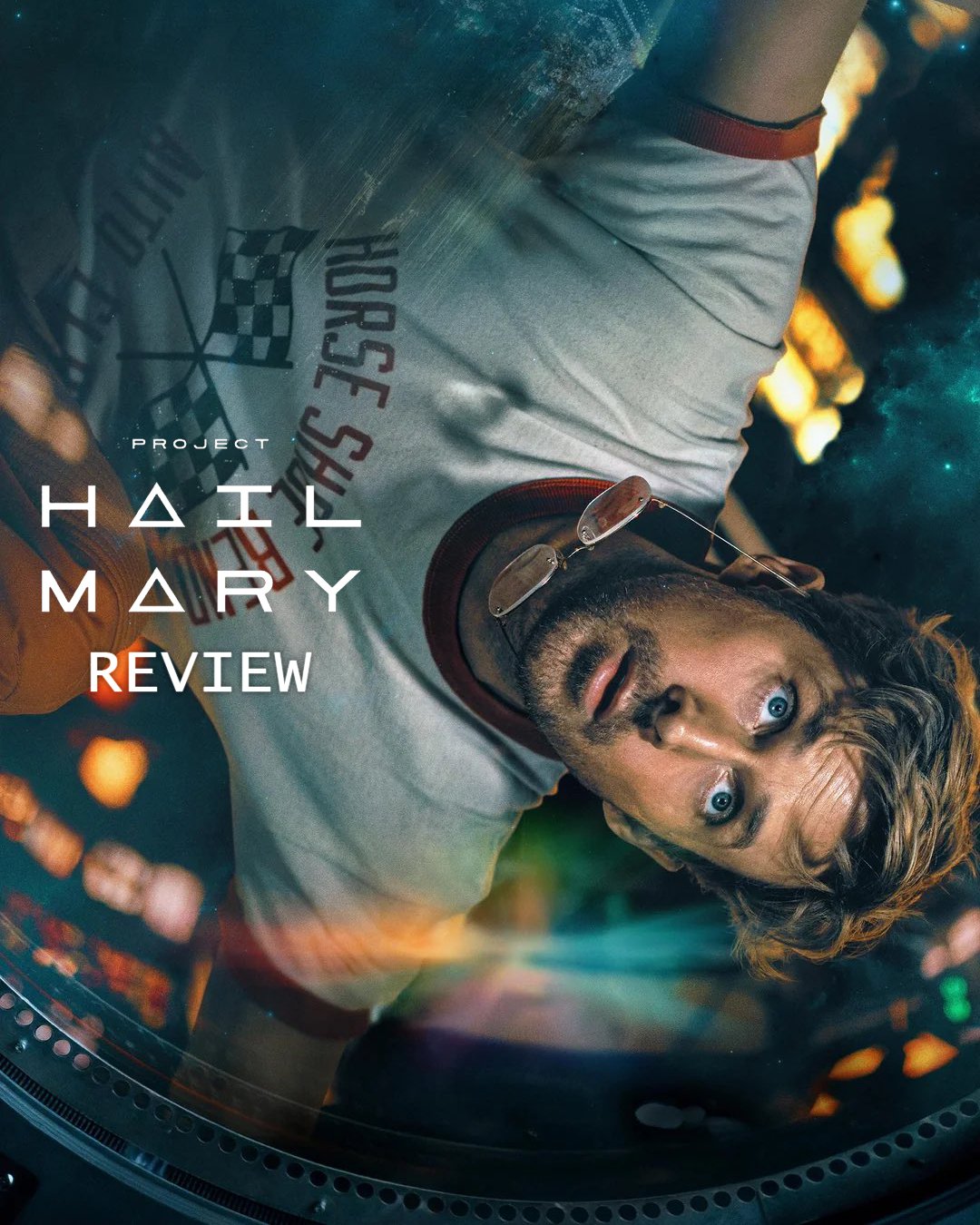
Amazon MGM Studios’Project Hail Mary is the kind of movie that makes you remember why theaters exist. It delivers wonder with discipline, emotion with intelligence, and spectacle with a human heartbeat. I walked in excited. I walked out convinced I had just watched a modern sci-fi classic.
A Story That Earns Its Scope
The story starts with a simple, terrifying premise. Humanity faces an extinction-level clock. One ordinary science teacher wakes up light years away with no memory, then has to solve the impossible. I already go deep on the story’s mechanics and emotional spine in my review of the book. The film does not just adapt that journey. It brings it to life with confidence, clarity, and a sense of scale that feels mythic without losing intimacy. It never treats science as cold exposition. It treats science as hope in action.
The visuals are the film’s flex, not because they scream for attention, but because they feel honest. The production avoids green screen, which changes everything. Light behaves like light. Surfaces feel present. Skin tones stay grounded. Every glow feels motivated. The result looks masterfully simple and incomprehensibly elegant at the same time.
It is also gorgeous in a way that feels strangely plausible. Nothing looks too far outside our world’s visual language. However, the film frames it with such grace that it becomes cosmic. Color and shape choices stay subtle, yet vivid. The Hail Mary feels engineered, lived-in, and built under pressure. Space feels vast, but never sterile. The movie makes the unbelievable feel like it could exist five minutes from now.
Gosling, Rocky, And A Trio Of Performances That Make Project Hail Mary
Ryan Gosling gives a career performance. He makes Ryland Grace relatable from the first confused breath. He layers charm with panic, then turns panic into focus, then turns focus into courage. He sells the character’s growth as something earned, not scripted. He also does the hardest thing an actor can do in this genre. He makes thinking cinematic. At this pace, he feels like a front-runner for next year’s Oscars.
Then Rocky arrives and the movie finds its second heartbeat. Rocky’s voice work and puppeteering create a character so lovable the audience will instantly understand the phrase “I would die for him.” The performance lands because Rocky feels present. He feels physical. He feels reactive. His humor lands, his anxiety lands, and his warmth lands. The friendship becomes the movie’s engine, and it never feels forced.
Sandra Hüller brings steel and humanity as Eva Stratt. She’s the leader making the impossible happen. She plays resolute power without turning cold. She makes harsh choices feel necessary, not cruel. She holds the burden of leadership on her face, then keeps moving anyway. That balance keeps the film honest. Somebody has to make the hard call. She makes it, and she still reads human.
Sound That Wraps Around You
The sound design and score fully engulf the room. The film keeps you close to Grace, even when the story goes interstellar. You feel the ship’s hum. You feel distance as silence. You feel danger as vibration. The music also carries a hopeful pulse that never turns cheesy. It supports emotion without telling you what to feel. In a movie like this, sound becomes physical storytelling. Here, it becomes immersion.
Project Hail Mary Radiates Magic Of Movies, The Inspiration Of Possibility
This is what makes movies feel magical. Every department shows up at the highest level. Direction, production design, cinematography, effects, editing, performance, sound, all of it locks into one shared goal. The film also pulls off a rare trick. It sells huge ideas while keeping everything emotionally understandable.
Most of all, Project Hail Mary feels possible. Not in the literal sense, but in the way great science fiction should feel. It makes you believe humans could solve impossible problems with curiosity and cooperation. You can already tell young filmmakers and future engineers will name-drop this movie as a reason they started. It carries that kind of spark and why I give the film a
10/10
Project Hail Mary opens exclusively in theaters on Friday, March 20, 2026. See it on the biggest screen you can, ideally IMAX, because the film’s scale and lighting design deserve room. Go with someone who loves science, someone who loves character drama, and someone who swears they do not cry at movies. This story will test all three.
Goofs:continuity:
On Ilyukhina’s uniform, the Russian space agency name is misspelled in Cyrillic as “Kosmoros” instead of “Roskosmos”. At the same time, the correct “Roskosmos” spelling is visible on the ship in other scenes, indicating inconsistent prop text within the film.continuity:
At several points during the film, the voice modulation translator for Rocky conveys words with emotion or strain. Because these are canned responses in a computer, Rocky’s emotions should have no bearing on the output of the words. However, this artistic license was likely done for the benefit of better connecting the audience with Rocky.continuity:
During Grace and Rocky’s mission to Adrian to retrieve the Astrophage-eating amoeba, their ship visibly glows from atmospheric re-entry heating, implying the presence of a dense atmosphere causing significant drag. However, Grace’s spacesuit shows no such heating effects. Even if the suit were designed to withstand re-entry temperatures, the same atmospheric drag would still impart substantial aerodynamic forces, likely causing him to be blown off course rather than remain stable.factual error:
After being in a coma for a long time, Grace wakes up with his beard and hair long. However, his fingernails are short. In a coma, hair and nails continue to grow, because the person is not dead.factual error:
Multiple orange traffic cones are shown on the deck of an aircraft carrier, and one character uses one to throw up into. Orange cones usually have a hole at the top, so the vomit would simply flow out of the cone. Also, no loose objects are allowed on aircraft carriers, including traffic cones.factual error:
Any work with an extraterrestrial microbe with unknown infection potential would likely need to be done in a flow box, but the film does not show any use of one beyond Grace examining Blip B and taking the Adrian samples from the collector.not a goof:
Grace severs the docking tube between his and Rocky’s ships, even though it was already established that it could be detached and retracted without the need to damage it.
Correction: Grace did this so scientists on Earth would have an ample supply of xenonite to study and try to replicate, since the material is extremely versatile. This isn’t explained well in the movie, but it was in the book.not a goof:
Mary the computer says “foreign presence detected” when Grace opens the lid of the artifact sent by the alien, yet it didn’t say a word when the artifact was introduced in the first place. The computer alert is actually triggered when the opened artifact releases some of Rocky’s residual atmosphere into the lab. Grace even makes a shocked face when he sniffs the content of the cylinder (in the book it’s explained that Eridian atmosphere is mostly ammonia).not a goof:
Xenon can be forced to be metallic, but only under great pressure — tens of thousands of atmospheres’ worth. When the pressure is reduced to normal, the xenon reverts to a gas. However, Rocky’s artifacts are not made of pure xenon (it’s called xenonite, to indicate that it’s a compound). In the book Grace explains that it’s “a complicated chain of proteins and chemicals” and that the hand-held scanner cannot identify chemical elements below aluminum – that’s why it shows only xenon when it scans Rocky’s artifacts.revealing mistake:
During the space burial, the remains of the deceased astronauts are seen drifting out to space in a straight line at constant velocity relative to the Hail Mary. At the same time, Grace is experiencing artificial gravity during the eulogy scene. To create artificial gravity, the space ship would have been either accelerating or rotating. Either way, the astronauts’ remains would have been ejected at a constant speed while the spaceship was accelerating which is inconsistent with the observed straight line and constant velocity drifting relative to the Hail Mary.revealing mistake:
In the last conference table scene, Grace’s glasses are hanging from his right ear, then vanish, then reappear.
At other times, his glasses hang from his left ear.revealing mistake:
Ryland Grace is able to give himself an almost perfectly coiffed haircut, even though he just has an electric hair trimmer on board. A hairstyle like this would not be possible under these conditions.error in geography:
Even though the hardware store part of the film is set in the USA, the POS terminal clearly shows the logo for Selco Builders Warehouse. This is a UK only company.character error:
Grace adds two tubes to a centrifuge while testing samples. He adds them side by side. Even if he was using a self-balancing centrifuge, a trained scientist would habitually still add them opposite each other to ensure balance in the centrifuge.
Plots:
A science teacher wakes up alone on a spaceship. As his memory returns, he uncovers a mission to stop a mysterious substance killing Earth’s sun, and realizes that an unexpected friendship may be the key.
Middle school science teacher Ryland Grace (Ryan Gosling) wakes up on a spaceship light-years from home with no recollection of who he is or how he got there. As his memory returns, he begins to uncover his mission: to solve the riddle of the mysterious substance that is causing the sun to die out. He must call on his scientific knowledge and unorthodox ideas to save everything on Earth from extinction… but an unexpected friendship means he may not have to do it alone.
Twelve light-years away from home, Ryland Grace, a middle-school science teacher with a penchant for going against the grain, wakes up from an induced coma. His body is weak, his memory is foggy, and he is in for a rude awakening: the bright dot on the star chart is not our sun. All alone on an eerily silent interstellar ship, Grace must piece together his fragmented memories to explain how he ended up in space and became entangled in a desperate, one-way mission to save humankind. It is a long shot; however, with our stars and sun dying, attempting the impossible is better than surrendering to extinction. In the endless void, the concepts of duty, selflessness, and mortality take on an entirely different, more profound meaning. But can Ryland believe in himself and the ambitious Project Hail Mary?
Ready to take the trip with Ryland Grace and meet Rocky? Do you want your sci-fi to lean harder into real science, or into pure wonder? Which will hit you first, the cosmic visuals or the friendship that sneaks up on you? Tell me in the comments or @me.




Leave a Reply