
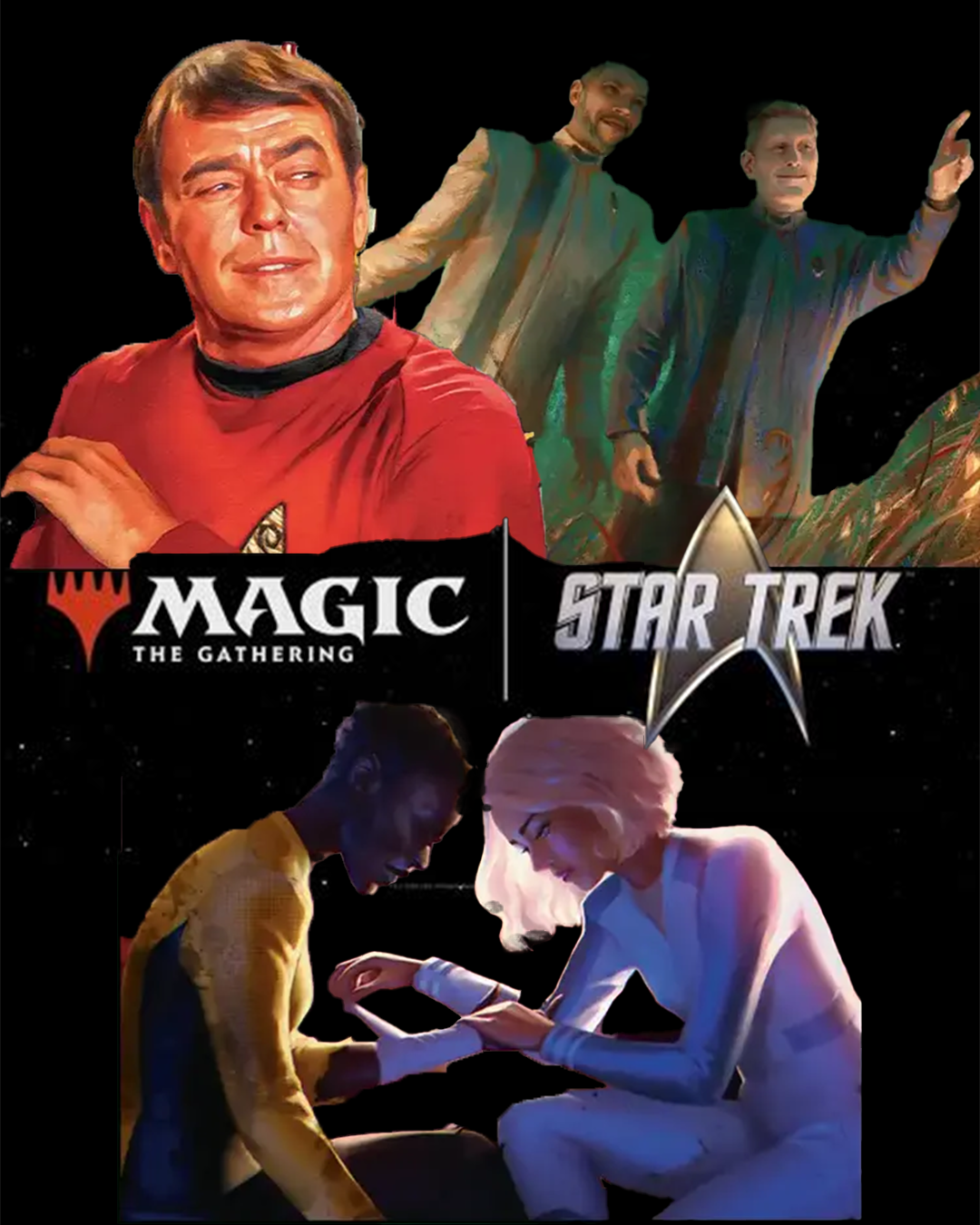
Magic: The Gathering | Star Trek could have settled for the easy crossover. Put Spock, Jean-Luc Picard, the Borg Queen, and the U.S.S. Enterprise on cards, let collectors fight over the fanciest treatments, then engage the warp drive directly toward the bank. Instead, the Star Trek cast panel at the U.S.S. Gathering launch celebration revealed why these two enormous universes fit together on a much deeper level. Bonnie Gordon, Anthony Rapp, Jess Bush, and Martin Quinn discussed how both fandoms gave self-described black sheep a place to belong, express themselves, and discover that the qualities once used to make them feel different could become their greatest strengths.
Every Deck Becomes a Personal Star Trek Story
Magic offers thousands of cards and an absurd number of possible combinations, but the game becomes meaningful when players decide which pieces feel like theirs. One person may build the cleanest competitive list possible. Another may refuse to cut a terrible card because it features their favorite character. A third may bring a deck held together entirely by spite, flavor, and an unhealthy commitment to making Tribbles everyone else’s problem.
That freedom makes every deck an act of self-expression. Rapp captured the idea during the panel while discussing the enormous number of choices available to players.
“It’s this game that all these people play that is your personal expression.”
That same personal connection has sustained Star Trek for 60 years. Fans do not simply remember episodes as collections of facts, ships, and stardates. They remember the character who helped them understand themselves, the captain whose principles shaped their worldview, or the story that made an imagined future feel possible.
Turning that history into Magic cards creates more than a checklist of recognizable references. The art and mechanics give players new ways to interpret those stories, combine eras that never met on screen, and decide what their version of the Star Trek universe looks like. A deck can put captains from different centuries on the same bridge, build an army of Klingons, unleash the Borg, or pursue peace while every opponent at the table makes that choice increasingly unreasonable.
The set does not replace the stories fans already love. It gives them another language for expressing that love.
The Black Sheep Finally Became the Cool Kids

The panel’s sharpest explanation for the crossover arrived when the conversation turned toward the communities surrounding both franchises.
“It is like bringing all the black sheep together.”
Magic’s Universes Beyond releases now connect players through worlds as different as Marvel, Middle-earth, and Star Trek. That variety could feel like a random pile of brands without the people sitting across from one another. At the table, however, every new universe gives someone another reason to join the game and another piece of themselves to bring with them.
The panel described that gathering of fandoms as something bigger than a product collaboration.
“It’s basically like all the outcasts coming together as one.”
That idea feels especially appropriate for Star Trek. The franchise has always imagined strength through difference. Its crews succeed because people with radically different cultures, abilities, histories, and perspectives learn how to work together without sanding away everything that makes them distinct.
RELATED: Magic: The Gathering x Star Trek Turns Exploration, Transporters, and the Borg Into New Mechanics
Magic operates on a similar principle. Players can approach the same game with completely different colors, formats, strategies, and definitions of fun. The person carefully negotiating a diplomatic solution and the person quietly assembling an apocalyptic combo still share the same table, at least until someone fails to read the obvious warning signs and lets the combo player untap.
For fans who grew up feeling too nerdy, too intense, too unusual, or simply out of place, those communities can transform isolation into identity. The panel did not dance around how dramatically that cultural status has changed.
“The outcasts have now become the cool thing. It’s the nerds. And now you feel powerful.”
The nerds did not suddenly become cool because they abandoned the things that made them targets. They built communities large enough that the rest of the culture finally had to recognize their passion, creativity, knowledge, and buying power. The black sheep found one another, compared deck lists, and discovered they had enough people to fill a starship.
The Cards Honor the People Behind 60 Years of Star Trek

Seeing a beloved character on a Magic card carries a different weight when the actor who helped create that character is sitting beside it. Gordon voices the U.S.S. Protostar’s computer in Star Trek: Prodigy. Rapp played Paul Stamets throughout Star Trek: Discovery. Bush and Quinn brought Christine Chapel and Montgomery Scott into a new era through Star Trek: Strange New Worlds.
Each performer represents one part of a franchise built by generations of actors, writers, directors, designers, artists, and fans. The panel praised how the cards honor that collective work instead of reducing six decades of storytelling to names and statistics.
“The art of these cards honors the work of so many incredible storytellers. It’s really, really beautiful.”
That artwork lets players hold a specific interpretation of a character, ship, or defining moment in their hands. The mechanics then ask a harder question: What does that person actually do?
A successful adaptation cannot stop at making a card look like Scotty or Chapel. It must translate ingenuity, courage, curiosity, leadership, sacrifice, and occasionally spectacularly bad decision-making into something players can experience. The card becomes a tiny argument about what matters most in that character’s story.
The panelists also turned the celebration into an invitation. Experienced players could test the new cards, while newcomers had access to learn-to-play tables and people ready to guide them through their first games. Nobody needed decades of Magic knowledge to come aboard.
As the panel joked, resistance was futile.
Sixty Years Still Feels Like the Beginning

The final question looked toward the next 60 years of Star Trek. The easy answer would have celebrated longevity and stopped there. Instead, the panel treated six decades as proof that the franchise still has room to grow.
“Star Trek has lasted 60 years, and I feel like it’s only just starting.”
That optimism comes directly from the fans. When The Original Series ended and years passed before The Next Generation reached television, the community kept the universe alive. People continued watching, organizing, discussing, and imagining what could come next. The franchise survived because its audience refused to treat cancellation as the end of the mission.
“The community continues to grow. It continues to become stronger.”
Magic has endured through its own changes, expansions, formats, arguments, and doomsday predictions. New mechanics and new universes arrive, but the fundamental experience remains recognizable: people gather around a table, reveal something about themselves through the cards they chose, and create a story that did not exist before they sat down.
RELATED: Star Trek Cast Explains Why Trekkies and Magic: The Gathering Players Belong at the Same Table
One panelist even predicted that humanity could discover evidence of extraterrestrial life within the next 60 years. That would certainly give Star Trek plenty of new material, although Wizards should probably let first contact breathe for at least a week before announcing the Secret Lair.
Magic: The Gathering | Star Trek is available now on MTG Arena and launches globally for tabletop play on Nov. 13, 2026. The set celebrates 60 years of Star Trek stories, but the U.S.S. Gathering panel made its future sound just as important as its history. Both franchises continue because the black sheep keep finding one another, welcoming new people aboard, and believing there are still strange new worlds left to explore.

Which Star Trek character are you most excited to build around? Does the set capture what has kept the franchise alive for 60 years? Which Star Trek actor should Wizards invite to play Commander next? Share your thoughts in the comments or @me.
KEEP READING: Star Trek Secret Lair Beams In Lower Decks, Khan, Klingons, and New Worlds
Leave a Reply